Overview
Home Assistant is the foundation of my smart-home automation environment, bringing together connected devices, household systems and services into a centralised platform.
The project is driven by a preference for owning and controlling personal technology infrastructure rather than relying on fragmented manufacturer applications, proprietary ecosystems and cloud-dependent services.
The objective is to create a home environment where devices work together intelligently, routine activities can be automated, and household information is accessible through a central interface.
The Problem
Modern smart-home products frequently operate within separate ecosystems. Different manufacturers provide their own applications, automation capabilities and cloud services, often with limited interoperability.
This creates unnecessary complexity and makes it difficult to build meaningful automation across different devices and platforms.
I wanted a central system that could bring these technologies together, provide greater control over how they interact and reduce unnecessary dependence on external services.
The Solution
Home Assistant provides the central automation and integration platform for the household.
It brings together compatible devices, integrations, sensors and services, allowing them to interact through shared automations and dashboards.
Rather than treating smart-home devices as isolated products, the approach is to build an integrated environment where information and automation can flow between systems.
Key Objectives
- Centralise smart-home devices and integrations.
- Reduce dependence on individual manufacturer applications.
- Automate routine household activities.
- Improve household visibility through dashboards and interfaces.
- Integrate environmental information, sensors and connected devices.
- Maintain greater control over household data and automation logic.
- Build reliable automations that operate with minimal intervention.
- Create a platform that can evolve as household requirements change.
Household Integration
Home Assistant is intended to sit alongside the broader Daly home infrastructure.
It provides an opportunity to integrate:
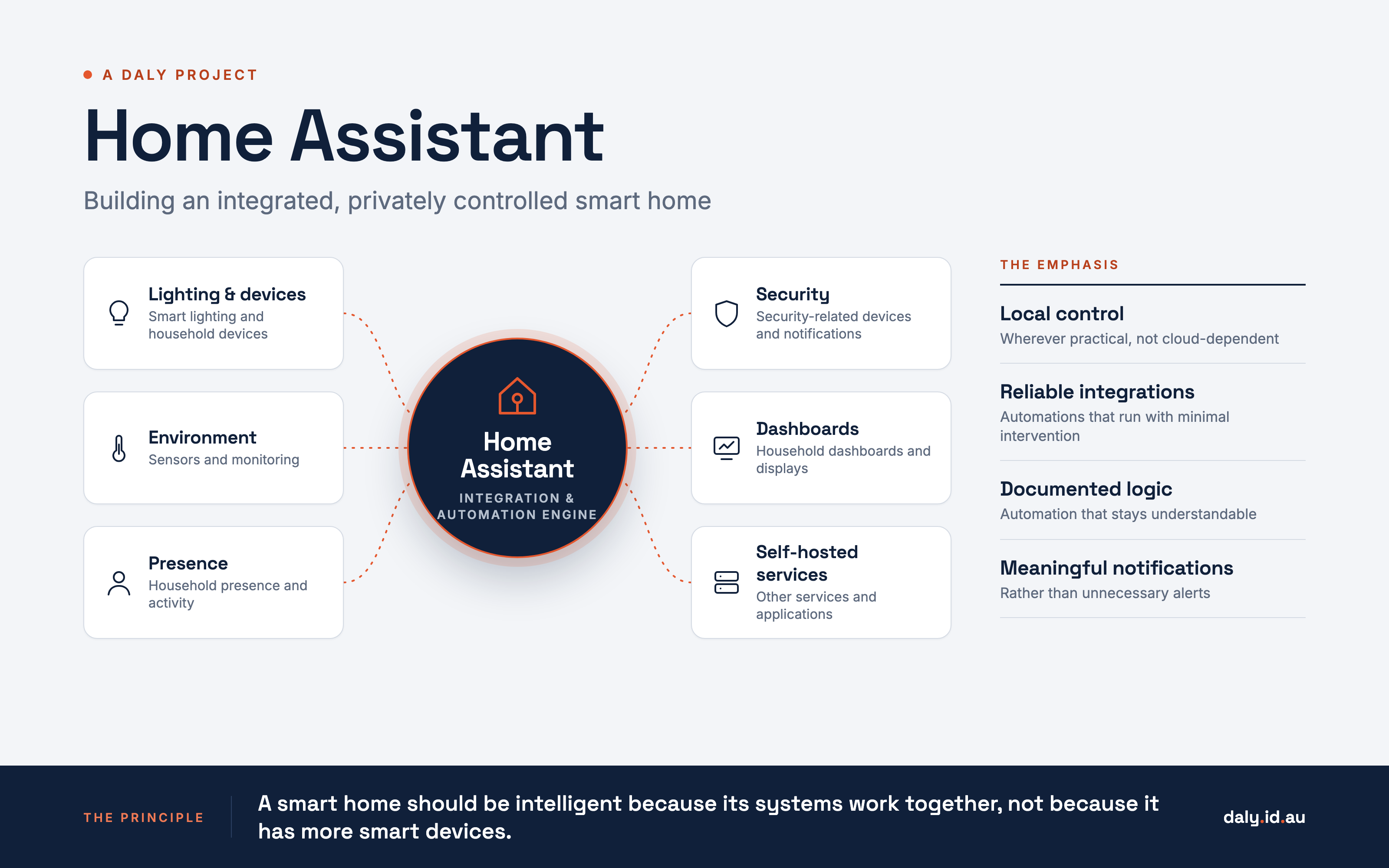
- Smart lighting and household devices.
- Environmental sensors and monitoring.
- Household presence and activity.
- Security-related devices and notifications.
- Household dashboards and displays.
- Other self-hosted services and applications.
The broader objective is to make household technology work together rather than maintain multiple disconnected systems.
Technical Approach
Home Assistant acts as the central integration and automation engine.
The emphasis is on:
- Local control wherever practical.
- Reliable integrations.
- Well-documented automation logic.
- Meaningful notifications rather than unnecessary alerts.
- Maintaining visibility over dependencies and external services.
- Regular review of automations, security and system reliability.
What It Demonstrates
This project demonstrates the practical application of open-source software to everyday household infrastructure.
It reflects a broader philosophy of building systems that are owned, configurable and interconnected, rather than depending on multiple commercial platforms to manage different aspects of daily life.
It also provides an ongoing opportunity to explore automation, integration, monitoring and the practical use of technology within the home.
Outcome
A centralised smart-home platform providing the foundation for household automation and connected services.
Home Assistant forms an important component of the broader Daly digital ecosystem, connecting physical household infrastructure with the software and services used to manage it.
The principle: A smart home should be intelligent because its systems work together, not because it has more smart devices.